 Help & Contact
 Order Tracking


Chicken Dewormers
Chicken Dewormers and Poultry Worm-Control Products
```Internal parasites can affect a chicken’s digestion, body condition, growth, activity and egg production. Heavy parasite burdens may become particularly serious in young, stressed or weakened birds.
The Chicken Dewormers collection at ChickenAntibiotics.com brings together poultry worm-control products and supportive flock-care essentials. Available options must be evaluated according to the target parasite, active ingredient, current product label and suitability for chickens.
Not every chicken with diarrhea, weight loss or reduced production has worms. Similar signs may result from coccidiosis, bacterial disease, poor nutrition, toxins, stress or other health conditions. Proper identification helps prevent unnecessary or ineffective treatment.
```Common Types of Worms in Chickens
```Roundworms
Roundworms live in the intestinal tract and can interfere with normal digestion and nutrient absorption. Heavy burdens may contribute to weight loss, reduced growth, diarrhea and poor condition.
Cecal Worms
Cecal worms inhabit the ceca of chickens. They may produce limited visible signs but can play an important role in transmitting other poultry diseases.
Capillary Worms
Capillary worms are thin, hair-like parasites that may affect different areas of the digestive tract. Heavy infections can contribute to weakness, weight loss and reduced appetite.
Tapeworms
Tapeworms can infect chickens that consume intermediate hosts such as insects, slugs or other small invertebrates. Segments may occasionally be visible in fresh droppings.
Gapeworms
Gapeworms affect the respiratory tract rather than the intestines. Infected birds may gasp, cough or stretch their necks. These signs can resemble other serious respiratory conditions and require careful evaluation.
```Possible Signs of Worms in Chickens
```Chickens with internal parasites may display:
- Weight loss or poor body condition
- Reduced appetite
- Slow growth in young birds
- Persistent diarrhea or abnormal droppings
- Pale comb and wattles
- Reduced activity
- Ruffled or poor-quality feathers
- Reduced egg production
- Visible worms or segments in fresh droppings
- Gasping or neck stretching in possible respiratory parasite cases
These signs are not specific to worms. A fecal examination performed through a veterinarian or diagnostic service can help confirm whether parasites are present and identify the likely type.
```Types of Chicken Deworming Products
```Water-Soluble Chicken Dewormers
Some worm-control products may be administered through drinking water when this route is supported by the exact product label. Accurate preparation and monitoring of water consumption are essential.
Liquid Poultry Dewormers
Liquid products may be intended for individual administration or preparation in drinking water. Concentrations differ between formulas, so instructions cannot be transferred from one product to another.
Poultry Deworming Powders
Powdered products require careful measurement and preparation. Verify the active ingredient, intended species, administration route and complete directions before use.
Feed-Administration Products
Certain products may be intended for administration through poultry feed. Use only when this method is explicitly supported by the current label and follow all preparation, duration and withdrawal requirements.
Natural Parasite-Support Products
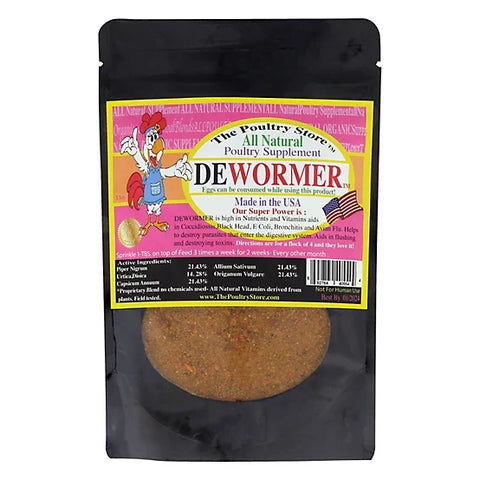
Herbal, botanical and nutritional products may support general digestive or flock wellness, but they should not automatically be described as proven dewormers. Disease-treatment and parasite-elimination claims require appropriate evidence and legal authorization.
```How to Choose a Dewormer for Chickens
```Review the following information before selecting a poultry worm-control product:
- The suspected or confirmed parasite
- Active ingredient
- Product concentration
- Intended animal species
- Chicken age and body condition
- Individual, water or feed administration
- Need for veterinary authorization
- Suitability for laying hens
- Egg and meat withdrawal instructions
- Potential need for follow-up testing
A product effective against one type of worm may not control another. Confirming the parasite helps avoid unnecessary treatment and supports more effective flock management.
```Testing Chickens for Internal Parasites
```A fecal examination can help determine whether worm eggs or other intestinal parasites are present. Testing is especially useful when symptoms are unclear, treatment has not worked or repeated parasite problems affect the flock.
A fresh sample may be submitted through a poultry veterinarian or animal diagnostic service. Results should be interpreted alongside the chicken’s symptoms, environment and flock history.
```Responsible Use of Chicken Dewormers
```- Observe the flock. Record weight changes, droppings, appetite, activity and egg production.
- Identify the likely parasite. Examine fresh droppings and obtain fecal testing when possible.
- Read the exact product label. Confirm chickens, the target parasite and the proposed administration route.
- Measure accurately. Product concentrations and preparation instructions vary.
- Treat only as directed. Do not increase the amount, frequency or duration without professional guidance.
- Monitor the response. Reevaluate birds that remain weak or continue losing condition.
- Improve environmental management. Reduce reinfection pressure through sanitation and pasture or run management.
Do not combine different dewormers or administer several parasite-control products simultaneously unless directed by a veterinarian.
```Chicken Dewormers for Laying Hens
```Chickens producing eggs for human consumption are food-producing animals. Many deworming products discussed online may not be labeled for laying hens or may require veterinary guidance and egg-discard instructions.
Before administering a chicken dewormer, verify:
- Whether chickens are included on the label
- Whether the product is permitted for laying hens
- Whether eggs must be discarded
- The required egg-withdrawal period
- The required meat-withdrawal period
- Whether veterinary authorization is necessary
There is no universal withdrawal period for all chicken dewormers. Follow the exact product label and instructions supplied by the prescribing veterinarian.
```Helping Reduce Worm Problems in a Chicken Flock
```Worm eggs and intermediate hosts can persist in the environment. Management practices can help reduce exposure and reinfection:
- Remove heavily soiled or wet bedding
- Clean feeders and waterers regularly
- Prevent chickens from eating directly beneath contaminated roosts
- Avoid overcrowding
- Improve drainage in wet runs
- Rotate outdoor areas when practical
- Control insects and other intermediate hosts appropriately
- Quarantine and evaluate new birds
- Use fecal testing to monitor recurring problems
- Avoid unnecessary routine deworming without evidence of need
When to Contact a Poultry Veterinarian
```Seek professional assistance when a chicken has severe weight loss, inability to stand, pronounced weakness, heavy diarrhea, blood in the droppings, significant breathing difficulty or continued deterioration.
A veterinarian can help distinguish worms from coccidiosis, bacterial disease, nutritional deficiencies and other conditions with similar symptoms.
```Chicken Dewormers Frequently Asked Questions
```How do I know if my chickens have worms?
Possible signs include weight loss, diarrhea, reduced growth, pale combs, poor feather condition and decreased egg production. Fecal testing offers more reliable evidence than symptoms alone.
Can worms be seen in chicken droppings?
Adult worms or tapeworm segments may occasionally be visible, but many infections cannot be confirmed through visual inspection alone.
Does one dewormer treat every chicken worm?
No. Products differ in the parasites they control. Identify the likely worm and review the exact product label before treatment.
Can chicken dewormer be mixed with drinking water?
Only when water administration is included on the current label or supplied through lawful veterinary instructions.
Can eggs be eaten after deworming chickens?
Egg restrictions depend on the exact product and intended use. Follow the product label and veterinarian’s egg-discard or withdrawal instructions.
```




ABOUT THIS COLLECTION
Chicken Dewormers
Read MoreShow Less
Chicken Dewormers and Poultry Worm-Control Products
```Internal parasites can affect a chicken’s digestion, body condition, growth, activity and egg production. Heavy parasite burdens may become particularly serious in young, stressed or weakened birds.
The Chicken Dewormers collection at ChickenAntibiotics.com brings together poultry worm-control products and supportive flock-care essentials. Available options must be evaluated according to the target parasite, active ingredient, current product label and suitability for chickens.
Not every chicken with diarrhea, weight loss or reduced production has worms. Similar signs may result from coccidiosis, bacterial disease, poor nutrition, toxins, stress or other health conditions. Proper identification helps prevent unnecessary or ineffective treatment.
```Common Types of Worms in Chickens
```Roundworms
Roundworms live in the intestinal tract and can interfere with normal digestion and nutrient absorption. Heavy burdens may contribute to weight loss, reduced growth, diarrhea and poor condition.
Cecal Worms
Cecal worms inhabit the ceca of chickens. They may produce limited visible signs but can play an important role in transmitting other poultry diseases.
Capillary Worms
Capillary worms are thin, hair-like parasites that may affect different areas of the digestive tract. Heavy infections can contribute to weakness, weight loss and reduced appetite.
Tapeworms
Tapeworms can infect chickens that consume intermediate hosts such as insects, slugs or other small invertebrates. Segments may occasionally be visible in fresh droppings.
Gapeworms
Gapeworms affect the respiratory tract rather than the intestines. Infected birds may gasp, cough or stretch their necks. These signs can resemble other serious respiratory conditions and require careful evaluation.
```Possible Signs of Worms in Chickens
```Chickens with internal parasites may display:
- Weight loss or poor body condition
- Reduced appetite
- Slow growth in young birds
- Persistent diarrhea or abnormal droppings
- Pale comb and wattles
- Reduced activity
- Ruffled or poor-quality feathers
- Reduced egg production
- Visible worms or segments in fresh droppings
- Gasping or neck stretching in possible respiratory parasite cases
These signs are not specific to worms. A fecal examination performed through a veterinarian or diagnostic service can help confirm whether parasites are present and identify the likely type.
```Types of Chicken Deworming Products
```Water-Soluble Chicken Dewormers
Some worm-control products may be administered through drinking water when this route is supported by the exact product label. Accurate preparation and monitoring of water consumption are essential.
Liquid Poultry Dewormers
Liquid products may be intended for individual administration or preparation in drinking water. Concentrations differ between formulas, so instructions cannot be transferred from one product to another.
Poultry Deworming Powders
Powdered products require careful measurement and preparation. Verify the active ingredient, intended species, administration route and complete directions before use.
Feed-Administration Products
Certain products may be intended for administration through poultry feed. Use only when this method is explicitly supported by the current label and follow all preparation, duration and withdrawal requirements.
Natural Parasite-Support Products
Herbal, botanical and nutritional products may support general digestive or flock wellness, but they should not automatically be described as proven dewormers. Disease-treatment and parasite-elimination claims require appropriate evidence and legal authorization.
```How to Choose a Dewormer for Chickens
```Review the following information before selecting a poultry worm-control product:
- The suspected or confirmed parasite
- Active ingredient
- Product concentration
- Intended animal species
- Chicken age and body condition
- Individual, water or feed administration
- Need for veterinary authorization
- Suitability for laying hens
- Egg and meat withdrawal instructions
- Potential need for follow-up testing
A product effective against one type of worm may not control another. Confirming the parasite helps avoid unnecessary treatment and supports more effective flock management.
```Testing Chickens for Internal Parasites
```A fecal examination can help determine whether worm eggs or other intestinal parasites are present. Testing is especially useful when symptoms are unclear, treatment has not worked or repeated parasite problems affect the flock.
A fresh sample may be submitted through a poultry veterinarian or animal diagnostic service. Results should be interpreted alongside the chicken’s symptoms, environment and flock history.
```Responsible Use of Chicken Dewormers
```- Observe the flock. Record weight changes, droppings, appetite, activity and egg production.
- Identify the likely parasite. Examine fresh droppings and obtain fecal testing when possible.
- Read the exact product label. Confirm chickens, the target parasite and the proposed administration route.
- Measure accurately. Product concentrations and preparation instructions vary.
- Treat only as directed. Do not increase the amount, frequency or duration without professional guidance.
- Monitor the response. Reevaluate birds that remain weak or continue losing condition.
- Improve environmental management. Reduce reinfection pressure through sanitation and pasture or run management.
Do not combine different dewormers or administer several parasite-control products simultaneously unless directed by a veterinarian.
```Chicken Dewormers for Laying Hens
```Chickens producing eggs for human consumption are food-producing animals. Many deworming products discussed online may not be labeled for laying hens or may require veterinary guidance and egg-discard instructions.
Before administering a chicken dewormer, verify:
- Whether chickens are included on the label
- Whether the product is permitted for laying hens
- Whether eggs must be discarded
- The required egg-withdrawal period
- The required meat-withdrawal period
- Whether veterinary authorization is necessary
There is no universal withdrawal period for all chicken dewormers. Follow the exact product label and instructions supplied by the prescribing veterinarian.
```Helping Reduce Worm Problems in a Chicken Flock
```Worm eggs and intermediate hosts can persist in the environment. Management practices can help reduce exposure and reinfection:
- Remove heavily soiled or wet bedding
- Clean feeders and waterers regularly
- Prevent chickens from eating directly beneath contaminated roosts
- Avoid overcrowding
- Improve drainage in wet runs
- Rotate outdoor areas when practical
- Control insects and other intermediate hosts appropriately
- Quarantine and evaluate new birds
- Use fecal testing to monitor recurring problems
- Avoid unnecessary routine deworming without evidence of need
When to Contact a Poultry Veterinarian
```Seek professional assistance when a chicken has severe weight loss, inability to stand, pronounced weakness, heavy diarrhea, blood in the droppings, significant breathing difficulty or continued deterioration.
A veterinarian can help distinguish worms from coccidiosis, bacterial disease, nutritional deficiencies and other conditions with similar symptoms.
```Chicken Dewormers Frequently Asked Questions
```How do I know if my chickens have worms?
Possible signs include weight loss, diarrhea, reduced growth, pale combs, poor feather condition and decreased egg production. Fecal testing offers more reliable evidence than symptoms alone.
Can worms be seen in chicken droppings?
Adult worms or tapeworm segments may occasionally be visible, but many infections cannot be confirmed through visual inspection alone.
Does one dewormer treat every chicken worm?
No. Products differ in the parasites they control. Identify the likely worm and review the exact product label before treatment.
Can chicken dewormer be mixed with drinking water?
Only when water administration is included on the current label or supplied through lawful veterinary instructions.
Can eggs be eaten after deworming chickens?
Egg restrictions depend on the exact product and intended use. Follow the product label and veterinarian’s egg-discard or withdrawal instructions.
```Chicken Dewormers and Poultry Worm-Control Products ``` Internal parasites can affect a chicken’s digestion, body condition, growth, activity and egg production. Heavy parasite burdens may become particularly seri...
